
A few years ago, setting up a massive LED wall, booking a photo booth, or bringing in a guest speaker was enough to make people stop and pay attention at an event.
Today, it takes a little more.
Walk into any large corporate event or exhibition and you will see LED screens, photo booths, interactive displays and branded installations everywhere. And with everyone constantly looking at their phones, getting people to actually stop, look up and interact with something has become harder than ever.
People want something different. Something unexpected, fun or interesting enough to photograph, record and talk about later. This is one of the reasons robots are becoming an exciting addition to corporate events, exhibitions, product launches and experiential marketing activations.
We’ve already seen humanoid robots such as Tesla’s Optimus attract enormous attention in public demonstrations. The interesting thing isn’t always what the robot is doing. Sometimes, it is simply the fact that a machine that looks and behaves like a person is performing an ordinary task. People stop because they want to see what it can do.
That curiosity is exactly what makes robots so interesting for events.
What Can a Robot Actually Do at an Event?
Before choosing a robot, it is important to understand what you actually want it to do. A robot doesn’t have to simply stand at the entrance and wave at guests. Depending on the hardware and software, it can become an entertainer, information assistant, brand ambassador, photographer, service assistant or even a presenter.
Some robots are designed primarily for entertainment. They can dance, perform programmed movements, interact with guests and become a natural photo opportunity. Others are more functional and can welcome visitors, provide event information, display schedules or guide people around the venue. Then there are AI-enabled robots that can have conversations with guests, answer questions and provide information about a product, brand or event.
And the possibilities don’t stop there. Robots can be used for registration, food and beverage service, photography, games, customer assistance, lead generation and much more.
Imagine walking through an exhibition with hundreds of similar-looking booths. You’ve already seen the LED walls, product displays and sales teams. Suddenly, a humanoid robot turns towards you and says hello. You stop, take a photograph and perhaps ask it a question.
The robot has already achieved something that every event marketer wants, it made a busy person stop.
Robot rental and its cost?
This is usually the first question event organisers ask, and there isn’t one fixed answer. The cost of renting a robot depends on the type of robot, duration, location, transportation, programming, customisation and the level of technical support required. If you want the robot to answer questions about your product, speak in a particular voice, display your branding or connect with another digital system, additional development may be required.
Large humanoid and service robots can be heavy and delicate and may require specialised transportation and handling, particularly when they need to travel between cities.
When comparing robot rental quotes, therefore, don’t look only at the rental price. Check what is actually included in the package.
A good checklist is:
- Transportation and logistics
- Setup and dismantling
- Programming and customisation
- Technical operator or handler
- Event-day support
- Charging and maintenance requirements
The cheapest robot isn’t necessarily the most cost-effective one if you later discover that transportation, programming or technical support is charged separately.
One Thing You Should Know: Robots Need Breaks Too
This is something that is often overlooked while planning a robot activation.
A humanoid robot may not be able to operate continuously for several hours. Depending on the model and kind, work and tempreture it operates, it may need charging, cooling or operational schedule.
So if your event runs for eight hours, you shouldn’t automatically assume that your robot can remain active for all eight hours.
Instead, plan the activation in sessions. For example, the robot could interact with guests for 30–45 minutes, take a break and return later. The actual operating time will depend entirely on the robot, so it is important to ask the supplier for the usable operating time under actual event conditions.
This is particularly important for humanoid robots because crowd interaction, movement and continuous activity can put considerably more demand on the system than simply having the robot switched on.
Good event planning means understanding the limitations of the technology before the event begins.
Types of Robots You Can Rent for an Event
When most people hear the word “robot”, they immediately imagine a humanoid. But event robotics is much broader than that.
Humanoid robots are probably the most visually impressive. With human-like movement, speech and sometimes facial expressions, they can become a major attraction at product launches, exhibitions, corporate events and technology conferences.
AI and conversational robots take interaction a step further. Depending on their technology, they can answer questions, provide information and have conversations with visitors. For a technology brand, this can become an experience in itself — rather than simply telling people what AI can do, you allow them to experience it.
Dancing and entertainment robots are designed primarily to create excitement. They can perform choreographed routines and work particularly well at college festivals, mall activations, children’s events and entertainment-led campaigns.
Reception and greeting robots are more functional. They can welcome guests, provide basic information, direct visitors to different areas and help create a technology-led first impression at corporate events and exhibitions.
Promotional and brand robots can be customised with brand messaging and content and used to attract visitors towards a product or activation. Instead of simply handing someone a brochure, the robot becomes the reason they stop and engage.
Then there are interactive and photo robots, which can capture photographs, create digital content and potentially share it directly with visitors through email, WhatsApp or other channels.
For schools and children’s events, educational and STEM robots can introduce concepts such as robotics, coding and artificial intelligence in a much more hands-on way.
And finally, there are custom robotic characters and mascots, where the robot itself becomes part of the creative idea and is designed around a particular brand, event or campaign.
The important thing is that the most advanced robot isn’t automatically the right choice. The right robot is the one that fits your audience and the experience you want to create.
How Can Robots Be Used at Corporate Events?
Once you stop thinking of a robot simply as an attraction, the number of possibilities becomes much bigger.
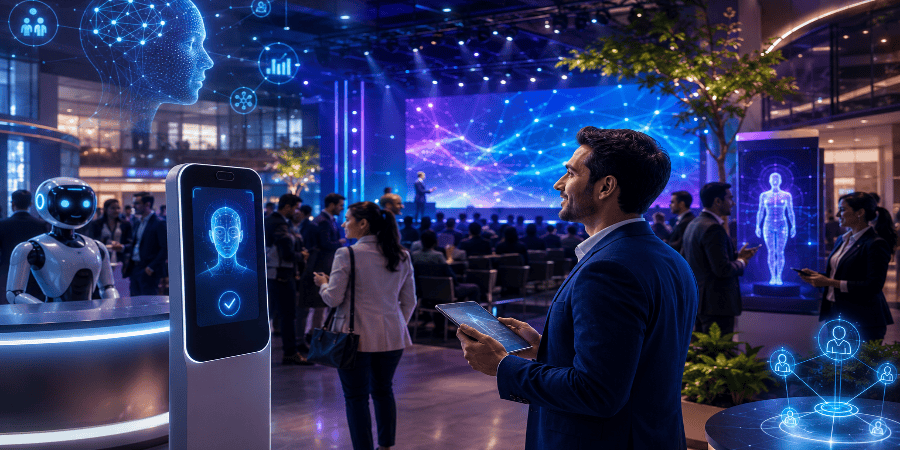
A robot can be part of the guest journey from the moment they enter the venue. It can assist with registration by scanning a QR code or ID, welcome guests, provide information about the event or guide visitors towards different zones.
It can also work as a smart information kiosk. Instead of looking at a static screen to find out where a session is taking place, guests can simply ask the robot.
For brands, robots can become part of product demonstrations, lead-generation activities and customer interactions. A service robot can deliver food, popcorn or beverages, while a photography robot can capture a guest’s photograph and send it directly to their phone.
There are also more creative possibilities. A robot can tell jokes, dance, play games, distribute promotional material or become part of an entertainment segment.
And then there is the idea of using a robot as a virtual presenter. Imagine a speaker who cannot physically attend an event but still wants to be part of the experience. A robot could act as their physical presence while the actual presenter participates remotely or provides the content.
Some possible corporate event applications include:
- Guest registration and check-in
- Welcome and guest assistance
- Smart information and enquiry desk
- Food and beverage service
- Photography and instant sharing
- Product demonstrations
- Lead generation
- Entertainment and games
- Brand promotions
- Virtual presentations
- Distribution of promotional material
The possibilities are still evolving. As robotics, AI and software become more capable, the role of robots at events will continue to expand.
The Robot Is Not the Experience. The Idea Is.
This is perhaps the most important point.
A robot by itself does not make an event successful. You can bring the most expensive humanoid robot to an exhibition, but if it is simply standing in one corner with nothing interesting to do, people will look at it once and move on.
On the other hand, a relatively simple robot can become the highlight of an event if it is placed inside a well-designed experience.
The question shouldn’t be, “Which is the most expensive or advanced robot we can rent?”
The better question is, “What do we want our audience to experience?”
Do you want them to laugh? Learn something? Interact with your brand? Create social media content? Try your product? Or simply experience something they haven’t seen before?
Once you answer that question, choosing the robot becomes much easier.
The future of event technology isn’t about replacing people with robots. It is about using technology to create new interactions, make certain tasks more efficient and give audiences experiences they are likely to remember.
And that’s where robots can make a real difference.
The success of an event will never depend on the robot alone. People are still at the centre of every great event. But the right robot, combined with the right idea, can enhance the experience, optimise the event and create a moment people remember long after they have gone home.
So, if you’re planning to rent a robot for your next corporate event, don’t start with the robot.
Start with the experience.